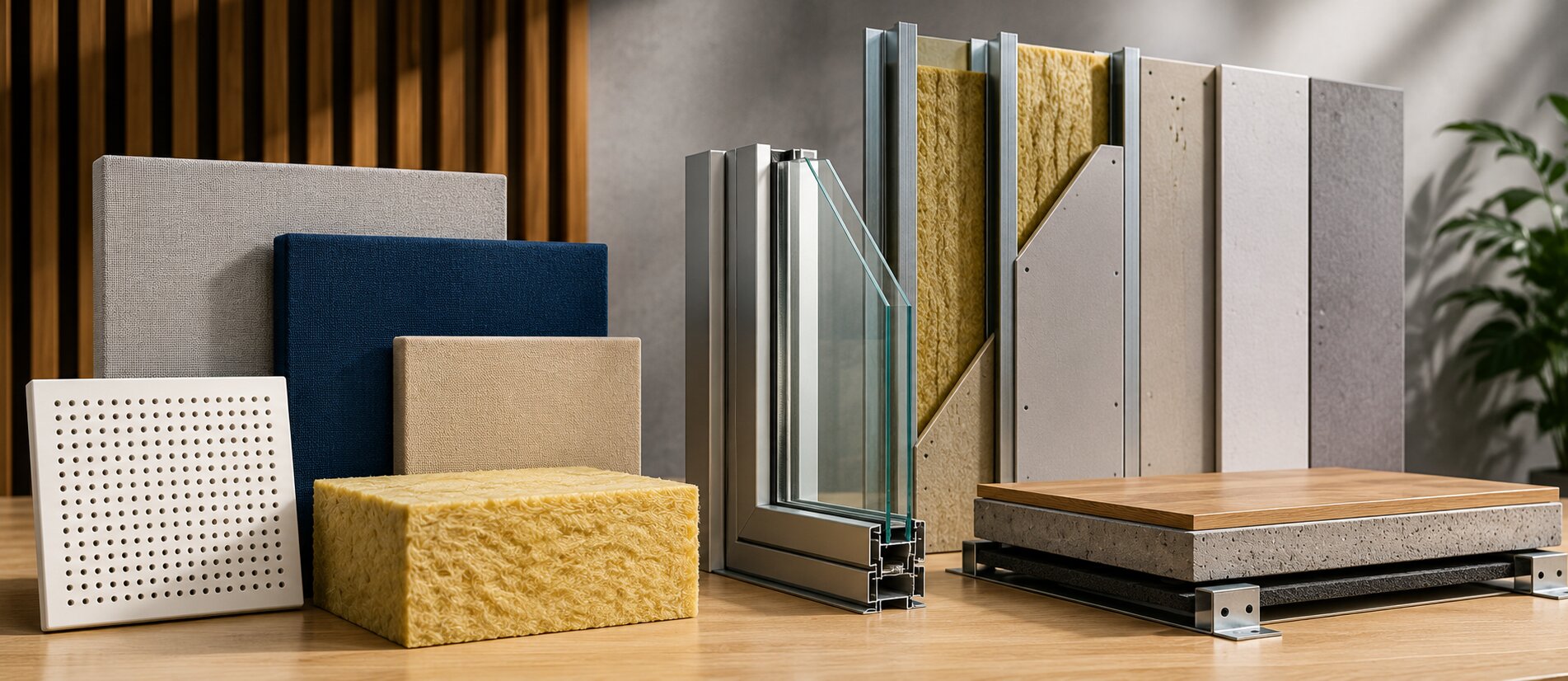
Acoustic design involves much more than simply adding sound-absorbing materials to a room. Different buildings have different acoustic requirements, and understanding the performance of acoustic materials and building elements is essential when selecting the right solution.
Three commonly encountered acoustic ratings are NRC, STC and IIC. Although these ratings are often mentioned together, they measure different aspects of acoustic performance.
NRC, STC and IIC ratings describe different acoustic performance
characteristics. Understanding what each rating measures helps in
selecting the right acoustic solution for a specific application.
What is NRC?
NRC stands for Noise Reduction Coefficient. It is commonly used to describe the sound absorption performance of an acoustic material or surface.
In simple terms, NRC indicates how effectively a material absorbs sound rather than allowing sound energy to reflect back into a room. It is particularly useful when comparing products such as acoustic ceiling panels, wall panels and other sound-absorbing materials.
A material with a higher NRC generally provides greater sound absorption than a material with a lower NRC, when comparing products under appropriate conditions.
Why NRC Matters in Acoustic Design
NRC is especially important when designing spaces where excessive reverberation and sound reflections need to be controlled. Classrooms, offices, restaurants, conference rooms, studios and public spaces can all benefit from appropriate sound absorption.
Acoustic designers consider NRC along with the size, location and quantity of absorptive surfaces. Simply choosing a high-NRC material does not automatically guarantee good room acoustics. The material must be used appropriately within the overall acoustic design.
What is STC?
STC stands for Sound Transmission Class. Unlike NRC, which relates primarily to sound absorption, STC is used to describe the sound insulation performance of building assemblies.
STC is commonly associated with walls, floors, doors, partitions and other building elements where the goal is to reduce the transmission of airborne sound from one space to another.
For example, STC can be an important consideration when designing offices, meeting rooms, apartments, hotels, educational facilities and other buildings where privacy and noise separation are required.
Why STC Matters in Acoustic Design
Imagine two adjacent offices separated by a partition. If the partition has poor sound isolation, conversations from one office may be clearly audible in the other.
Improving the acoustic performance of the separating construction can reduce the transmission of airborne sound and improve privacy. STC is one of the ratings used to evaluate and compare this type of performance.
What is IIC?
IIC stands for Impact Insulation Class. It is used to evaluate the ability of a floor-ceiling assembly to reduce the transmission of impact sounds.
Impact noise can be created by footsteps, furniture movement or objects striking a floor. Unlike airborne sound, impact noise is generated by physical contact with a building element.
IIC is therefore particularly relevant to multi-storey buildings, apartments, hotels, offices and other environments where noise from one floor can affect occupants below.
Why IIC Matters in Acoustic Design
A building may have good airborne sound isolation while still experiencing unwanted impact noise between floors. This is why both airborne and impact sound transmission need to be considered when designing floor-ceiling assemblies.
Flooring systems, resilient layers, underlayments and floor-ceiling constructions can all influence impact sound performance.
NRC vs STC vs IIC
- NRC: Relates primarily to the sound absorption performance of a material or surface.
- STC: Relates to the reduction of airborne sound transmission through a building assembly.
- IIC: Relates to the reduction of impact sound transmission through a floor-ceiling assembly.
These ratings should therefore not be treated as interchangeable. Each addresses a different acoustic challenge.
Where NRC is Commonly Used
NRC is commonly considered when selecting sound-absorbing products for occupied rooms. Typical applications include:
- Classrooms and lecture rooms
- Restaurants and dining areas
- Open-plan offices
- Conference rooms
- Recording and media spaces
- Reception and waiting areas
- Public and commercial interiors
In these environments, controlling sound reflections and reverberation can improve acoustic comfort and speech clarity.
Where STC is Commonly Used
STC becomes particularly important when sound needs to be contained between rooms or separated areas.
- Office partitions
- Apartment walls
- Hotel room partitions
- Meeting rooms
- Bedrooms
- Classrooms
- Healthcare spaces
Good sound isolation can improve speech privacy, occupant comfort and the overall acoustic performance of a building.
Where IIC is Commonly Used
IIC is most relevant in buildings where occupants may be affected by impact noise from spaces above.
- Residential apartments
- Hotels
- Multi-storey offices
- Educational buildings
- Mixed-use developments
Floor construction and suitable acoustic layers can help reduce the amount of impact noise transmitted to rooms below.
Absorption and Sound Isolation Are Different
One of the most common misunderstandings in acoustic design is assuming that a sound-absorbing product will automatically provide sound isolation.
Acoustic absorption and sound isolation address different problems. Absorption helps control sound within a room, while sound isolation aims to reduce sound transmission between spaces.
For example, an acoustic wall panel may reduce reflections inside a conference room, but it does not necessarily prevent conversations from passing through the wall into an adjacent room.
Choosing the Right Acoustic Rating
The appropriate acoustic rating depends on the problem being addressed.
- If the main problem is excessive reverberation inside a room, consider sound absorption and NRC.
- If the main problem is airborne noise travelling between rooms, consider sound isolation and STC.
- If the main problem is footsteps or impact noise travelling between floors, consider impact insulation and IIC.
In many projects, more than one acoustic strategy is required. A building may need absorptive treatments inside rooms as well as improved sound isolation between spaces.
Acoustic Ratings Should Not Be Considered in Isolation
Product ratings are useful tools, but they are only one part of acoustic design. Actual performance can depend on installation, room dimensions, construction details, flanking paths, workmanship and the interaction between different building elements.
This is why acoustic design should consider the complete building system rather than selecting products based only on a single rating.
Importance of Professional Acoustic Design
An acoustic consultant can assess the requirements of a space and determine which acoustic performance characteristics are most important.
Depending on the project, this may involve room acoustic analysis, sound insulation assessment, material selection, building-system evaluation and acoustic detailing.
Professional acoustic planning also helps ensure that acoustic treatments are integrated with architectural, mechanical and interior design requirements.
Acoustic Design by Ray Acoustics
At Ray Acoustics, we understand that every project has different acoustic requirements. Whether the goal is to control reverberation, improve sound isolation or reduce impact noise, selecting the appropriate acoustic approach is essential.
Our acoustic design solutions consider the performance requirements of the space along with architectural, functional and aesthetic considerations.
From offices and restaurants to educational facilities, healthcare environments, residential buildings and specialised spaces, acoustic planning can help create more comfortable and functional environments.
Conclusion
NRC, STC and IIC are important acoustic ratings, but each measures a different aspect of acoustic performance.
NRC helps describe sound absorption, STC relates to airborne sound isolation, and IIC relates to impact sound insulation. Understanding these differences makes it easier to identify the appropriate acoustic solution for a building or interior space.
The right acoustic design combines product performance, building construction, room requirements and professional acoustic planning. If you are planning an acoustic project and need help selecting the appropriate acoustic solutions, Ray Acoustics can help you develop a solution suited to your space.