Introduction: Why Acoustic Testing Matters in Thoraipakkam
Buildings in Thoraipakkam serve a wide range of purposes, including offices, commercial facilities, educational spaces, residential developments and specialised interiors. In each setting, sound conditions can influence communication, comfort, concentration and the usability of a room. Acoustic testing services in Thoraipakkam help turn sound-related concerns into measurable information that can guide design, troubleshooting and improvement work.
Acoustic testing is not a single measurement or a general noise check. The correct method depends on the question being investigated: how loud the environment is, how long sound persists inside a room, or how effectively a wall, floor, door or partition limits sound transmission. Selecting the appropriate test is essential for producing useful results.
Reliable acoustic assessment begins by defining the performance question,
choosing a suitable measurement method and recording the conditions under
which the test is carried out.
Different Types of Acoustic Measurements
1. Environmental and Indoor Noise Level Measurements
Sound level measurements help establish the noise present at a particular location and time. They may be relevant when assessing traffic intrusion, nearby commercial activity, plant rooms, air-conditioning systems or general background noise in occupied spaces. Readings should be planned around the purpose of the assessment and the operating conditions of the sound sources.
A measurement record should identify the location, duration, instrument settings and relevant site conditions. Where noise varies throughout the day, a single short reading may not represent the full pattern. Repeated or time-based measurements may be more appropriate.
2. Reverberation Time and Room Acoustic Testing
Reverberation time describes how quickly sound energy decays in a room after the sound source stops. It is commonly considered when evaluating classrooms, conference rooms, auditoriums, restaurants, offices and other spaces where speech or listening quality matters. A room with excessive reverberation can make speech less distinct, particularly when several people are communicating.
Measurements are taken at selected positions using a suitable test procedure. Results can be examined across frequency bands because a room may behave differently at low, middle and high frequencies. The findings help determine whether ceiling absorption, wall treatment, banners, baffles or other room-acoustic measures should be considered.
3. Airborne Sound Insulation Testing
Airborne sound insulation testing evaluates how much sound is reduced as it passes between adjoining rooms or spaces. It may be relevant for offices, meeting rooms, residential partitions, consultation rooms and other areas where speech privacy or separation is important. The test considers sound levels in the source room and receiving room, along with background conditions and the relevant measurement procedure.
The performance of a partition depends on more than its main surface. Doors, glazing, service penetrations, ceiling voids and flanking paths can influence the overall result. Testing can help identify whether the separating construction is meeting the intended acoustic requirement.
4. Impact Sound and Floor-Borne Noise Assessment
Impact sound is generated when a floor is excited by footsteps, dropped objects or movement of furniture and equipment. In multi-storey buildings, this type of noise can travel through the floor structure and be heard in rooms below or nearby. An impact sound test uses a defined excitation method and measurements in the receiving space to assess the sound transmission characteristics of the floor assembly.
Floor finishes, resilient layers, floating floor construction, junction details and structural connections can all affect performance. The assessment should be interpreted in relation to the construction and applicable project criteria.
Planning an Acoustic Test for Your Building
Before measurements begin, the testing objective should be agreed with the building owner, consultant or project team. The test plan should identify the rooms, boundaries or external locations to be assessed, the relevant operating conditions and the performance criteria, where these have been specified.
- Identify the sound concern and the decision the test results need to support.
- Confirm the rooms, measurement positions and access requirements.
- Record room dimensions, construction details and relevant finishes.
- Plan around occupancy, equipment operation and other background noise sources.
- Choose a measurement procedure appropriate to the required assessment.
- Agree how findings, limitations and recommendations will be reported.
Measurement Equipment and Test Conditions
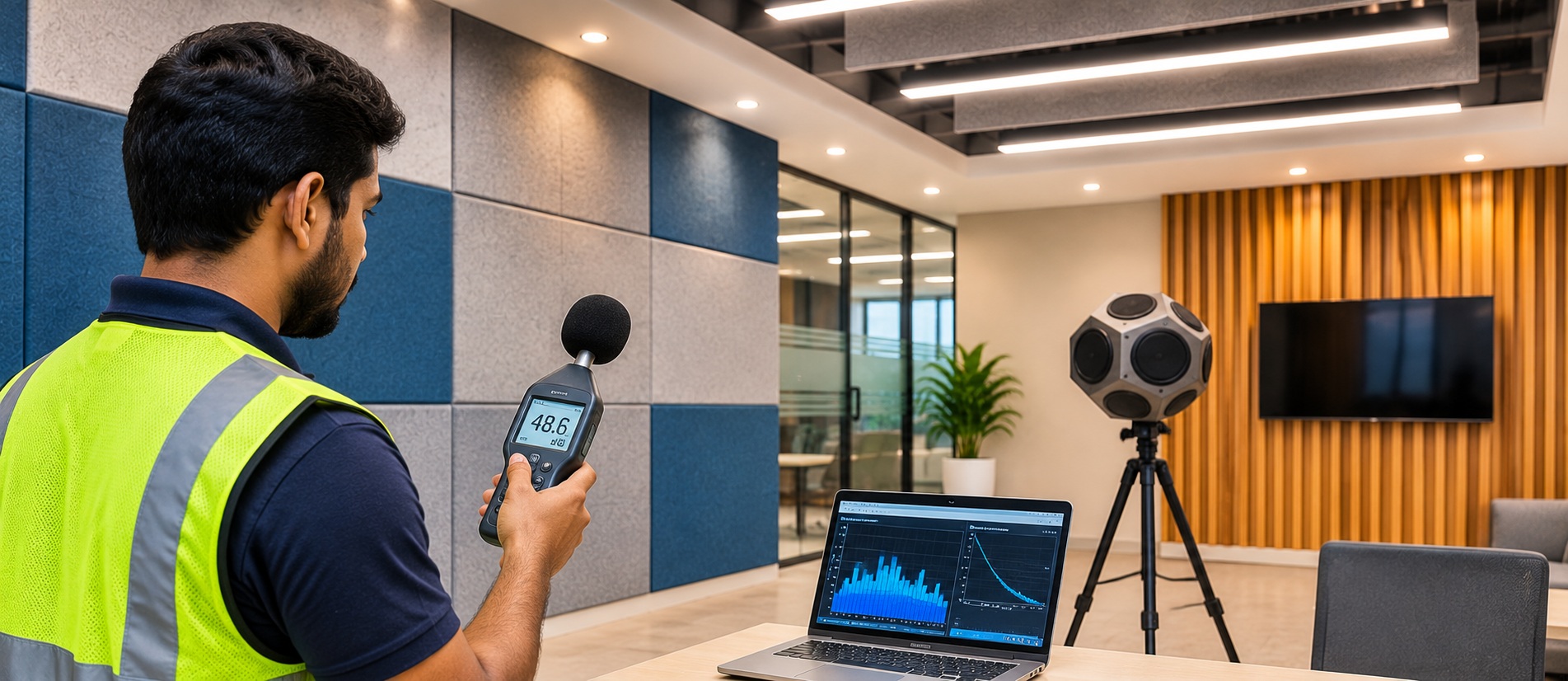
Acoustic measurements require suitable instruments and a controlled, documented approach. Depending on the test, equipment may include sound level meters, acoustic calibrators, measurement microphones, sound sources and data acquisition systems. Instrument capability and calibration status should be appropriate to the measurement being undertaken.
Site conditions also matter. Background noise, wind, room occupancy, doors and windows, HVAC operation and nearby activities can affect readings. The report should make relevant conditions clear so that results are not interpreted without context. Where a test condition cannot be achieved, the limitation should be recorded rather than hidden.
Understanding the Test Report
A useful acoustic test report should do more than list numbers. It should explain the purpose and scope of the test, the method followed, the equipment used, measurement locations, site conditions and the results obtained. Graphs or frequency-band tables can help show how performance changes across the measured range.
The report should distinguish measured findings from interpretation and recommendations. If the project has a stated target or standard, the comparison should identify the relevant criterion and any qualifications. A test result applies to the tested conditions and should not automatically be treated as proof of performance in every room or operating situation.
When Should Acoustic Testing Be Considered?
Testing can be useful during the design stage, before and after acoustic improvement work, during building commissioning, or when occupants report a persistent sound problem. Early assessment can establish a baseline and help the project team select suitable construction or treatment measures. Post-installation testing can help evaluate the outcome against the agreed scope and criteria.
For existing buildings, an investigation may begin with a site inspection and discussion with occupants. Measurements can then be selected to investigate the suspected issue rather than applying an unrelated test. This avoids confusing room echo, airborne noise, impact sound and equipment vibration, which require different approaches.
Acoustic Testing Support from Ray Acoustics
Ray Acoustics supports acoustic design and noise-control requirements for residential, commercial and specialised spaces in Chennai. Acoustic testing and assessment can provide project teams with information about indoor noise, reverberation and sound insulation, depending on the scope and requirements of the site.
For projects in Thoraipakkam, the testing plan should be matched to the building type, the concern being investigated and the intended use of the results. Clear objectives and properly documented conditions help make the findings more useful for design decisions and future improvements.
Conclusion
Acoustic testing helps establish how a building performs in relation to noise levels, room reverberation and sound transmission. The appropriate test depends on whether the concern involves background noise, speech clarity, airborne sound insulation or impact noise. Measurements become most valuable when they are planned carefully and interpreted in the context of the building and its use.
If you are planning an acoustic assessment or investigating a sound-related issue, acoustic testing services in Thoraipakkam can help identify the relevant performance questions and provide measured information for the next stage of the project.