Audio Engineer's Guide to Acoustic Treatment
For audio engineers, producers, and musicians, the quality of the listening environment is just as important as the quality of the equipment. Acoustic treatment is the art and science of controlling sound reflections, reverberation, and frequency response within a room to create an accurate and reliable monitoring environment. This comprehensive guide explores everything audio engineers need to know about acoustic treatment for professional results.
Whether you're setting up a home studio, upgrading a commercial facility, or simply trying to get better sound from your existing space, understanding acoustic treatment is essential. Unlike soundproofing (which prevents sound from entering or leaving a room), acoustic treatment optimizes how sound behaves inside the room, ensuring that what you hear is an accurate representation of your recordings and mixes.
"Acoustic treatment is the foundation of professional audio. Without it, even the most expensive equipment will produce inaccurate results. With it, modest gear can deliver professional-quality sound. The room is the most important component in any audio chain."
Understanding Room Acoustics
1. The Acoustic Triangle: Every listening room involves three elements: - Direct Sound: Sound that travels directly from speakers to your ears. - Early Reflections: Sound that reaches your ears within 20ms of the direct sound. - Late Reflections (Reverberation): Sound that arrives after multiple reflections, creating a sense of space.
2. Critical Listening Zones: The area where accurate monitoring is essential. This includes: - Sweet Spot: The exact listening position (typically forming an equilateral triangle with speakers). - Mix Position: The primary working position for mixing decisions. - Tracking Position: Where musicians perform during recording sessions.
3. Room Modes: Resonant frequencies determined by room dimensions: - Axial Modes: Between two parallel surfaces (most significant). - Tangential Modes: Between four surfaces. - Oblique Modes: Between all six surfaces. - Modal Distribution: How modes are spaced across the frequency spectrum.
4. RT60 (Reverberation Time): The time it takes for sound to decay by 60dB. Ideal RT60 for control rooms is 0.3-0.5 seconds. For live rooms, 0.5-1.5 seconds depending on the application. RT60 affects clarity, intelligibility, and the perceived sense of space in recordings.
Types of Acoustic Treatment
1. Absorption: Materials that convert sound energy into heat, reducing reflections. Common absorbers include: - Porous Absorbers: Fiberglass, mineral wool, acoustic foam. Effective across a broad frequency range, especially when mounted with an air gap. - Resonant Absorbers: Membrane/diaphragmatic absorbers, Helmholtz resonators. Targeted for specific problem frequencies, particularly in the low end. - Effective Frequency Range: Depends on thickness—typically 1/10th of wavelength is required for effective absorption (e.g., 4" thick for down to ~340Hz).
2. Diffusion: Materials that scatter sound reflections, preserving energy while reducing echoes. Key points: - Quadratic Residue Diffusers (QRD): Mathematical sequence creates even scattering. - Primitive Root Diffusers: Alternative mathematical approach. - Skyline Diffusers: 2D diffusion for more complex scattering patterns. - Effective Frequency Range: Determined by well depth and width—typically 1/4 wavelength minimum for effective diffusion.
3. Bass Traps: Specialized absorption for low frequencies. Types include: - Corner Bass Traps: Placed in room corners where bass energy accumulates. - Membrane Traps: Thin panels with sealed air cavities. - Helmholtz Resonators: Tuned cavities for specific frequencies. - Broadband Traps: Thick absorption covering a wide bass range.
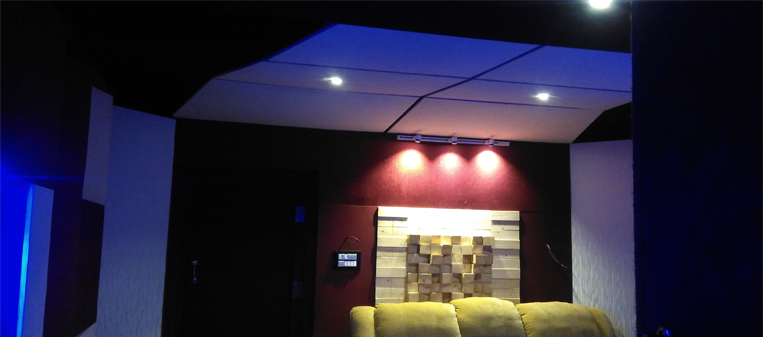
4. Reflection Control: Managing first reflections: - First Reflection Points: Walls, ceiling, and floor where early reflections occur. - Mirror Technique: Using mirrors to identify reflection points. - Cloud Panels: Suspended ceiling absorption to control ceiling reflections. - Side Wall Treatment: Absorption at side reflection points.
Placement Strategies for Acoustic Treatment
1. Monitor Setup: Optimize speaker placement: - Listening Position: 38% of room length from front wall (ideal). - Speaker Placement: Equilateral triangle with listening position, angled at 30-45 degrees. - Distance: Speakers at least 2-3 feet from walls. - Height: Tweeters at ear level for accurate high-frequency response.
2. First Reflection Points: Treat early reflections: - Side Walls: Absorption at left and right reflection points (using mirror technique). - Ceiling: Absorption cloud above the listening position. - Back Wall: Diffusion (to preserve energy) or absorption (to reduce reflections). - Floor: Carpet or rug to control floor reflections.
3. Bass Trap Placement: Manage low frequencies: - Corners: All four corners for full-range bass control. - Wall-Ceiling Junctions: Additional trapping at room perimeters. - Tri-Corners: Where walls meet ceiling for maximum bass pressure. - Front Wall: Behind speakers for SBIR (Speaker Boundary Interference Response) control.
4. Diffusion Placement: Enhance spatial quality: - Back Wall: Maintains room energy while reducing flutter echoes. - Side Walls (Behind Listening Position): Creates spaciousness while controlling reflections. - Ceiling: In larger rooms to maintain open sound. - Spacing: Minimum 2-3 feet from listening position for effective diffusion.
"The difference between a good mix and a great mix often comes down to the room. Acoustic treatment isn't just about fixing problems—it's about creating an environment where you can make confident decisions that translate to every listening system."
DIY Acoustic Treatment Options
1. Building Absorption Panels: Cost-effective DIY solutions: - Materials: Rigid fiberglass, mineral wool, or recycled denim insulation. - Fabric: Breathable fabric like Guilford of Maine or similar. - Wood Frame: Simple frames from 1x4 lumber. - Mounting: Direct to wall or with air gap for improved low-frequency absorption. - Size: 2'x4' or 4'x4' panels are standard sizes.
2. Superchunk Bass Traps: Effective corner bass traps: - Triangle Design: Fits perfectly in corners. - Filling: Stacked rigid fiberglass or mineral wool triangles. - Fabric Covering: Breathable fabric stretched over the triangular frame. - Height: Full room height for maximum bass absorption.
3. Diffusion Panels: DIY diffusers: - Simple Slot Diffuser: Alternating slats and slots on a panel. - QRD Design: Following mathematical sequence for even scattering. - Materials: Wood, MDF, or plastic. - Precision: Requires accurate construction for proper performance.
4. Isolation and Treatment: Combined solutions: - Acoustic Curtains: Heavy drapes for sound absorption and light isolation. - Movable Gobo Panels: Portable treatment for versatility. - Wall-Mounted Systems: Combined absorption/diffusion for optimized rooms.
Acoustic Measurement and Analysis
1. Measurement Microphones: Accurate measurement requires: - Omnidirectional Response: Consistent frequency response from all angles. - Calibration: Factory calibration for accuracy. - Frequency Range: Typically 20Hz to 20kHz.
2. Software Tools: Professional measurement software includes: - REW (Room EQ Wizard): Comprehensive free measurement software. - FuzzMeasure: Popular macOS measurement tool. - ARTA: Professional measurement suite. - Smart: Live: Real-time analysis for system calibration.
3. Key Measurements: Important acoustic metrics: - Frequency Response: Overall room response curve. - Waterfall Plot: Frequency vs. time decay. - RT60: Reverberation time at different frequencies. - ETC (Energy Time Curve): Reflection timing and intensity. - Phase Response: Time alignment of different frequencies.
4. Interpreting Results: Understanding measurements: - Target Response: Typically +/- 3dB or better. - Decay Times: Consistent decay across frequencies. - Early Reflections: At least 15-20dB down from direct sound. - Waterfall Analysis: Modes should decay quickly for accurate monitoring.
Common Acoustic Treatment Mistakes
1. Over-Absorption: Creating a dead, lifeless room. Solution: Balance absorption with diffusion and monitor with reference material.
2. Underestimating Bass: Neglecting low-frequency control. Solution: Invest in proper bass trapping, particularly in corners.
3. Incorrect Placement: Poor positioning of treatment. Solution: Use mirror technique and measurement to optimize placement.
4. Using Wrong Materials: Inappropriate absorption or diffusion. Solution: Select materials appropriate for your room and application.
5. Ignoring Symmetry: Asymmetrical treatment can cause imaging issues. Solution: Treat side walls and other surfaces symmetrically.
6. DIY Quality Control: Poor construction compromises performance. Solution: Build accurately, measure results, and be prepared to adjust.
7. Expecting Miracles: Treatment alone won't fix serious issues. Solution: Combine treatment with proper speaker placement, room selection, and listening habits.
Budget-Friendly Acoustic Treatment Approaches
1. Priority Placement: Focus on most critical areas first: - First reflection points (highest priority) - Corner bass traps (second priority) - Rear wall treatment (third priority) - Ceiling treatment (fourth priority)
2. DIY Projects: Build your own treatment: - Absorption panels (significant savings over commercial products) - Bass traps (cost-effective with proper materials) - Diffusers (requires precision but can be affordable)
3. Strategic Upgrades: Incremental improvements: - Start with 2x4' panels at first reflections - Add bass traps gradually - Upgrade to more effective solutions over time
4. Professional Consultation: Consider expert advice: - Prevent costly mistakes - Achieve better results with less expense - Get tailored recommendations for your specific room
"Great audio engineering starts with a great room. Acoustic treatment is the foundation upon which all your other investments—gear, skills, and creativity—can truly shine. Treat your room, and your mixes will treat you well."
Treatment vs. Soundproofing: Understanding the Difference
1. Acoustic Treatment: - Purpose: Optimizes sound inside the room. - Method: Absorption, diffusion, reflection control. - Materials: Acoustic panels, diffusers, bass traps. - Effect: Improves monitoring accuracy, reduces reflections. - Cost: Relatively affordable, DIY possible.
2. Soundproofing: - Purpose: Prevents sound transfer in/out of room. - Method: Mass, decoupling, absorption, damping. - Materials: Heavy materials, acoustic sealants, resilient channels. - Effect: Contains sound, prevents transmission. - Cost: Significant construction costs, complex.
3. Interaction: Both work together: - Soundproofing should be addressed during construction or renovation. - Treatment can be added to any room (within limits). - Neither replaces the other—both are essential for professional results.
Conclusion
Acoustic treatment is the foundation of professional audio production. For audio engineers, understanding and implementing proper acoustic treatment is essential for achieving accurate monitoring, confident mixing decisions, and professional-quality results that translate well to any playback system.
Whether you're building a commercial studio, setting up a home workspace, or simply trying to improve your existing room, the principles of acoustic treatment apply universally. Start by understanding your room's dimensions and acoustics, prioritize treatment placement, and invest in the right combination of absorption, diffusion, and bass control.
At Ray Acoustics, we specialize in helping audio professionals create optimal listening environments. From consultation and design to implementation and measurement, our acoustic experts provide the guidance and expertise you need to achieve professional results.
Remember: The room is the most important component in your audio chain. Treat it well, and it will serve you for years of successful productions.