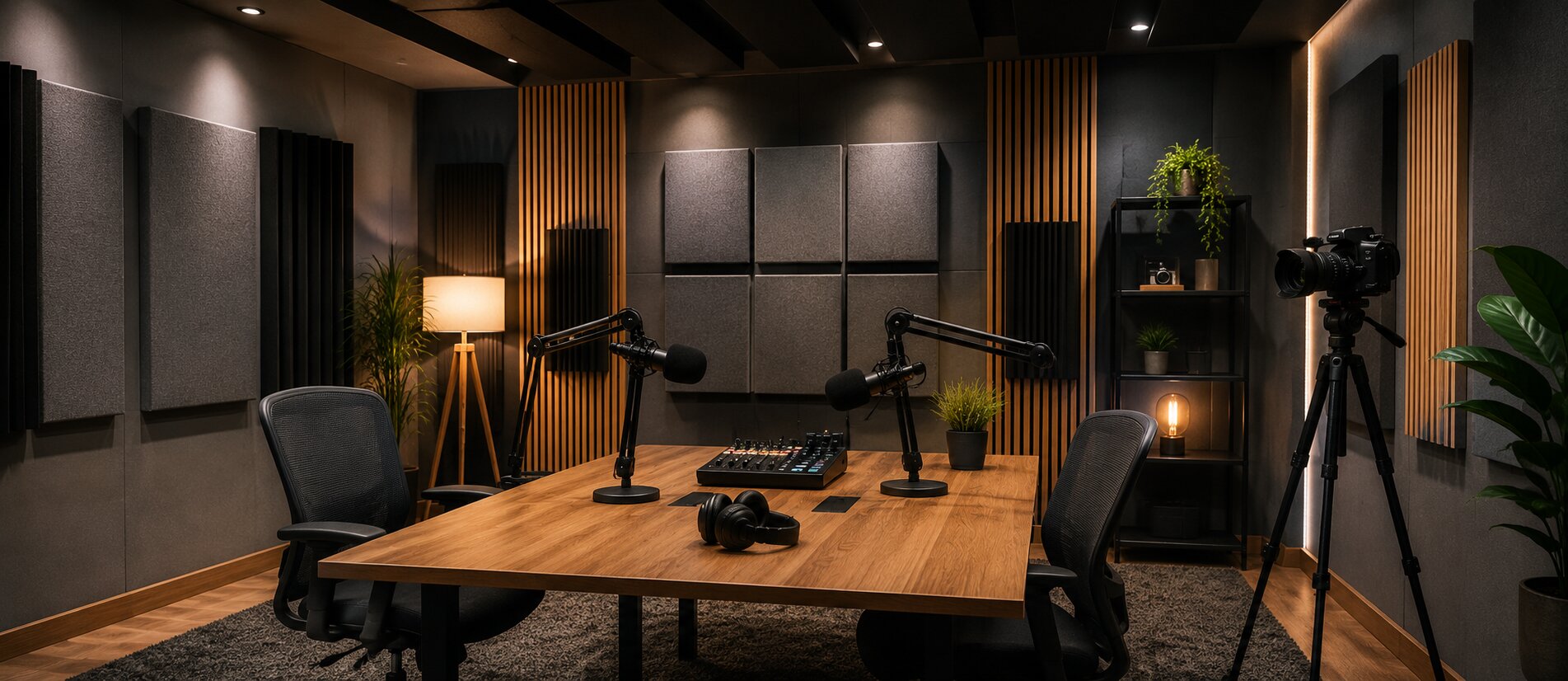
Podcasts, YouTube videos and other online media depend heavily on clear and natural-sounding audio. While a good microphone and recording equipment are important, the room itself can have a major effect on the quality of the final recording.
Hard walls, ceilings, floors, glass surfaces and other reflective materials can cause sound to bounce around a room. These reflections may create echo, reverberation and an unnatural sound that can make speech harder to understand.
A good podcast or YouTube studio does not simply need expensive
recording equipment. It also needs a room that has been acoustically
treated for clear, controlled and comfortable sound.
What Is Acoustic Treatment?
Acoustic treatment refers to the use of specially designed materials and surfaces to control the behaviour of sound inside a room. The objective is generally to reduce unwanted reflections and excessive reverberation while maintaining a natural acoustic environment.
Acoustic treatment is different from soundproofing. Soundproofing focuses on reducing the transmission of sound between spaces, whereas acoustic treatment focuses primarily on improving the sound within the room itself.
This distinction is particularly important for podcast and YouTube studios because the recording environment directly affects the clarity of voices and other recorded sounds.
Why Room Acoustics Matter for Podcasts and YouTube
Spoken-word content requires clear and intelligible audio. When a room has too many reflective surfaces, the microphone can capture both the direct voice and multiple reflected sound waves.
This can make the recording sound distant, boxy, harsh or echoey. Excessive room reflections can also make post-production more difficult.
A properly treated recording room can provide a more controlled acoustic environment, helping voices sound cleaner and more natural.
Start With the Room
Before selecting acoustic products, it is important to understand the room itself. The dimensions, shape, ceiling height, floor finish, wall construction and furniture arrangement can all affect the acoustic behaviour of a studio.
Small rooms can present their own acoustic challenges because reflections between nearby surfaces can become particularly noticeable. Larger rooms may require a different distribution of acoustic treatment.
The goal is not necessarily to make the room completely silent or acoustically dead. Instead, the objective is to achieve a balanced and controlled acoustic environment suitable for the type of content being recorded.
Use Acoustic Panels to Control Reflections
Acoustic panels are one of the most common solutions for controlling reflections in podcast and YouTube studios.
Porous acoustic panels can absorb a portion of the sound energy that would otherwise reflect from walls and ceilings. Strategic placement can help reduce excessive reverberation and improve speech clarity.
Panels can be installed on selected wall surfaces rather than covering every available surface. Their location should be determined according to the room layout and the positions of the microphone, speakers, presenters and other reflective surfaces.
Control the First Reflections
First reflections are sound reflections that reach the microphone or listener shortly after the direct sound. In a recording studio, uncontrolled early reflections can affect the perceived clarity and tonal balance of the recording.
Identifying and treating important reflection points can therefore be an effective part of an acoustic treatment strategy.
Depending on the room, treatment may be required on side walls, rear walls or ceiling surfaces.
Consider Ceiling Treatment
The ceiling is sometimes overlooked when treating small recording rooms. However, a hard ceiling can create strong reflections between the presenter, microphone and floor.
Suspended acoustic panels, clouds or other ceiling treatments can help control these reflections while also contributing to overall reverberation control.
Ceiling treatment can be particularly useful in rooms with hard flooring and other reflective finishes.
Do Not Ignore the Floor
Floors can also influence room acoustics. Hard surfaces such as tile, concrete and polished flooring can reflect sound strongly.
Carpets and rugs can provide some high-frequency absorption and may help reduce reflections from the floor.
However, floor treatment should be considered as part of the overall acoustic strategy rather than being relied upon as the only treatment in the room.
Manage Low-Frequency Problems
Low-frequency sound behaves differently from higher-frequency sound. In smaller rooms, bass energy can build up in corners and create uneven low-frequency response.
Depending on the room and recording requirements, bass traps or other low-frequency acoustic solutions may be considered.
Effective low-frequency management can contribute to a more balanced monitoring and recording environment.
Choose the Right Microphone Position
Acoustic treatment works together with microphone placement. Positioning the microphone and presenter appropriately can help reduce the amount of unwanted reflected sound captured during recording.
The microphone should not simply be placed in the centre of the room without considering nearby walls, corners and reflective surfaces.
A carefully planned recording position can make the acoustic treatment more effective.
Furniture Can Affect Studio Acoustics
Furniture, shelves, curtains and other interior elements can also influence the way sound behaves inside a studio.
Soft furnishings can provide some additional absorption, while irregular surfaces may help reduce strong repetitive reflections.
However, furniture should complement a properly designed acoustic treatment system rather than replace it.
Podcast Studio Acoustic Treatment
Podcast studios usually place strong emphasis on voice clarity. The acoustic environment should allow microphones to capture speech without excessive room reflections.
- Control excessive reverberation.
- Reduce strong wall and ceiling reflections.
- Improve speech clarity.
- Maintain a natural and comfortable room sound.
- Consider low-frequency behaviour where required.
The exact amount and type of treatment depends on the size, construction and intended use of the podcast room.
YouTube Studio Acoustic Treatment
YouTube studios may be used for interviews, educational videos, product demonstrations, livestreams, voice-over work and other content formats.
Because these studios can serve multiple purposes, the acoustic treatment should be designed to provide a controlled environment without unnecessarily affecting the visual appearance of the space.
Fabric-wrapped panels, acoustic clouds and other architectural acoustic products can be incorporated into the room while supporting the overall interior design.
Acoustic Treatment vs Soundproofing
It is important to understand that acoustic treatment does not automatically prevent sound from entering or leaving a recording room.
If external traffic, neighbouring rooms, HVAC equipment or other sources are affecting the recording, sound isolation may also need to be considered.
Soundproofing and acoustic treatment solve different problems and may need to be combined depending on the project requirements.
Common Acoustic Treatment Mistakes
- Using too few acoustic panels.
- Covering only one wall and ignoring other reflection paths.
- Treating only high frequencies while ignoring low-frequency problems.
- Placing acoustic products without considering microphone position.
- Making the room excessively absorptive.
- Assuming acoustic treatment is the same as soundproofing.
- Choosing products based only on appearance rather than acoustic performance.
How Much Acoustic Treatment Does a Studio Need?
There is no single amount of acoustic treatment that works for every podcast or YouTube studio. The requirement depends on room dimensions, surface finishes, construction, equipment placement and the intended recording style.
A smaller room with several hard surfaces may require a different treatment approach from a larger room containing furniture and other absorptive elements.
This is why acoustic assessment and planning are valuable before purchasing and installing treatment products.
Designing a Professional Recording Environment
A professionally designed podcast or YouTube studio should consider the entire acoustic environment rather than focusing on individual acoustic panels.
Room geometry, surface finishes, acoustic absorption, low-frequency control, microphone placement, equipment arrangement and sound isolation can all contribute to the final recording quality.
Good acoustic design can also make the studio more comfortable for presenters, guests and production teams.
Acoustic Solutions by Ray Acoustics
At Ray Acoustics, we provide acoustic design solutions for a wide range of spaces, including podcast studios, YouTube studios, recording rooms, media spaces and professional work environments.
Our approach focuses on understanding the acoustic requirements of the space before recommending suitable treatment solutions.
From sound absorption and reverberation control to acoustic panels, ceiling treatments and other specialist solutions, the objective is to create a recording environment that supports clear and consistent audio.
Conclusion
High-quality audio begins with more than a good microphone. The acoustic characteristics of the room can have a significant effect on how voices and other sounds are captured.
Proper acoustic treatment can help reduce unwanted reflections, control reverberation and improve speech clarity in podcasts and YouTube recordings.
Acoustic panels, ceiling treatments, floor coverings, low-frequency solutions and appropriate microphone positioning can all contribute to a more controlled recording environment.
The best results come from treating the room as a complete acoustic system rather than simply adding panels wherever space is available.
If you are planning a podcast studio, YouTube studio or professional recording space, Ray Acoustics can help develop an acoustic treatment strategy suited to the room, recording requirements and interior design.