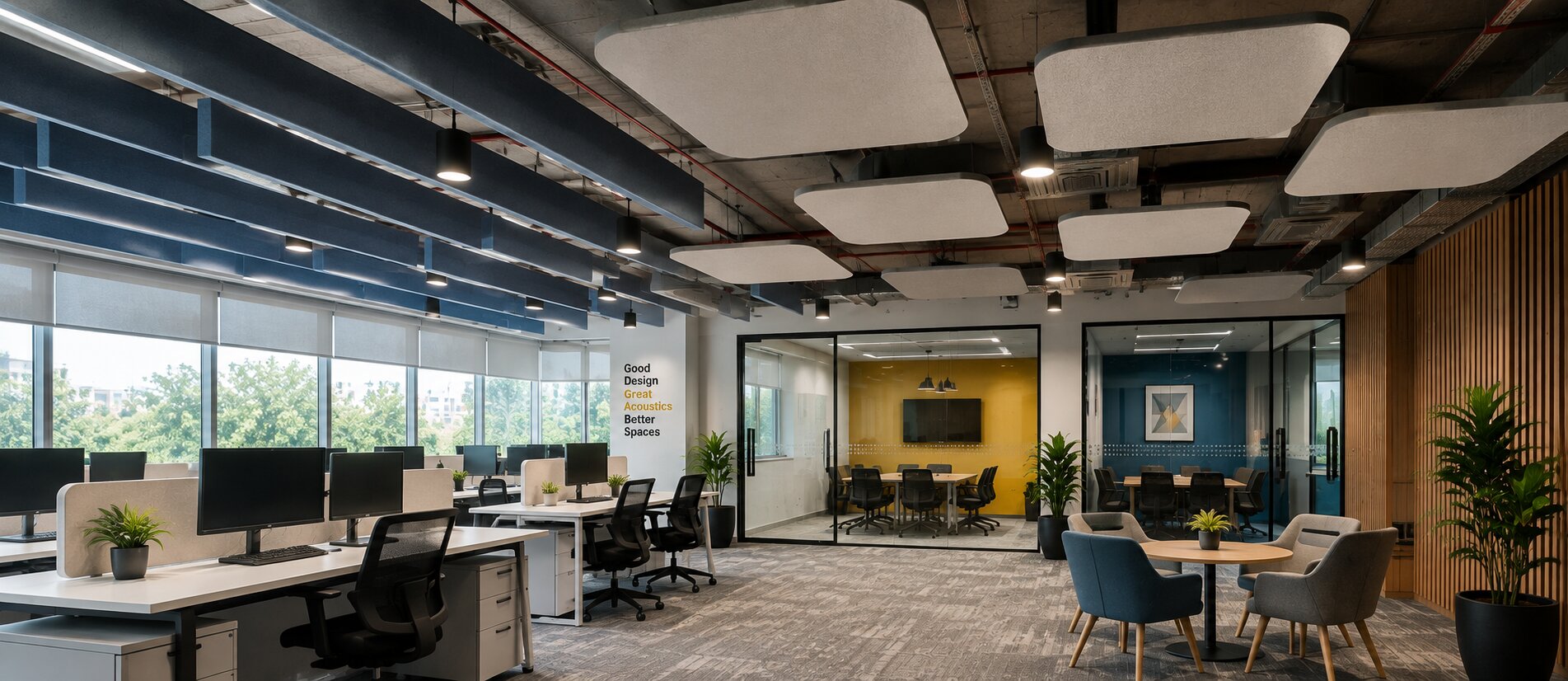
Modern buildings often combine open layouts, hard surfaces, glass, metal and other contemporary finishes. While these materials can create attractive interiors, they can also contribute to excessive sound reflections and reverberation.
One of the most effective areas to consider when improving room acoustics is the ceiling. Acoustic ceiling solutions can absorb unwanted sound reflections while integrating with the architectural appearance of the space.
A well-designed acoustic ceiling can improve sound comfort while
becoming an integral part of the interior design.
What Are Acoustic Ceiling Solutions?
Acoustic ceiling solutions are systems or products installed at or suspended from the ceiling to help control sound within a room. They are commonly used to reduce reverberation, absorb reflected sound and improve acoustic comfort.
Depending on the requirements of the space, designers may use acoustic ceiling panels, suspended acoustic clouds, acoustic baffles or complete acoustic ceiling systems.
The appropriate solution depends on the room size, ceiling height, interior design, required acoustic performance and building services.
Why the Ceiling Matters in Room Acoustics
Ceilings can represent a significant percentage of the reflective surface area within a room. Hard ceilings can reflect sound back into occupied areas, increasing reverberation and reducing acoustic comfort.
This can be particularly noticeable in offices, restaurants, educational facilities, auditoriums, meeting rooms and other spaces where clear communication is important.
Treating the ceiling can therefore be an important part of a complete acoustic design strategy.
Acoustic Ceiling Panels
Acoustic ceiling panels are sound-absorbing panels designed to reduce unwanted reflections from the ceiling.
They can be installed directly against the ceiling or suspended depending on the product and project requirements.
Ceiling panels are often suitable for offices, classrooms, conference rooms and other spaces where a clean and integrated ceiling appearance is preferred.
What Are Acoustic Baffles?
Acoustic baffles are vertical or suspended sound-absorbing elements installed below the ceiling. They provide additional absorbing surfaces while allowing the existing ceiling structure and building services to remain visible.
Because baffles expose acoustic material on multiple surfaces, they can provide useful sound absorption in spaces with high ceilings or exposed services.
Acoustic baffles can also be arranged in different patterns to complement the architectural design of a room.
Advantages of Acoustic Baffles
- Effective use of ceiling space.
- Suitable for high or exposed ceilings.
- Can provide significant sound absorption.
- Can be arranged in creative architectural patterns.
- Can work around existing lighting and mechanical services.
Baffles are particularly useful when a conventional closed ceiling system is not suitable for the architectural or functional requirements of the space.
What Are Acoustic Clouds?
Acoustic clouds are suspended horizontal acoustic elements installed below the main ceiling. They are often used to create a floating acoustic feature within a room.
Because an acoustic cloud is suspended below the ceiling, both the top and bottom surfaces can contribute to sound absorption depending on the design.
Acoustic clouds can be especially useful in open-plan offices, meeting spaces, educational environments and other areas where architectural appearance is important.
Acoustic Clouds vs Acoustic Baffles
The main difference between clouds and baffles is their orientation. Clouds are generally horizontal, while baffles are generally vertical.
Acoustic clouds can provide a visually defined ceiling feature, whereas baffles can be arranged vertically to create a more dynamic architectural effect.
The choice between the two depends on the room configuration, ceiling height, acoustic requirements and design objectives.
How Acoustic Ceiling Panels Reduce Reverberation
Reverberation occurs when sound continues to reflect within a space after the original sound has been produced.
Excessive reverberation can make conversations difficult to follow and reduce speech clarity.
Sound-absorbing ceiling treatments convert a portion of the sound energy into a small amount of heat within the absorbing material, reducing the amount of sound reflected back into the room.
This can help create a more controlled acoustic environment.
Acoustic Ceiling Solutions for Offices
Open-plan offices can experience significant levels of reflected sound and background noise because of their large open spaces and multiple conversations.
Acoustic clouds, baffles and ceiling panels can be used to reduce reverberation and improve acoustic comfort.
Ceiling treatments can also be coordinated with lighting, HVAC systems and other building services.
Acoustic Ceilings for Classrooms
Clear speech is essential in educational spaces. Excessive reverberation can make it difficult for students to understand teachers and lecturers.
Acoustic ceiling panels, clouds or baffles can help reduce unwanted reflections and create better listening conditions.
Ceiling treatment should be considered together with wall absorption, sound isolation and background noise control.
Acoustic Ceiling Solutions for Restaurants
Restaurants often contain hard flooring, glass, furniture and decorative surfaces that can reflect sound.
When multiple conversations occur at the same time, the overall noise level can increase significantly.
Suspended acoustic clouds and baffles can help control reflections while also becoming an attractive part of the restaurant's interior.
Acoustic Ceilings for Auditoriums and Large Spaces
Large rooms and auditoriums require careful acoustic planning because of their volume, ceiling height and large reflective surfaces.
Acoustic ceiling elements can be used alongside wall treatments, diffusers and other acoustic systems to achieve the required acoustic performance.
The solution should be selected according to the room's intended use and acoustic requirements.
Exposed Ceiling Acoustic Design
Many modern commercial and industrial interiors use exposed ceilings with visible ducts, pipes, lighting and structural elements.
Covering these services with a conventional ceiling may not be desirable. Acoustic baffles and suspended acoustic panels can provide sound absorption while maintaining the exposed-ceiling aesthetic.
This makes them useful for contemporary offices, studios, restaurants, educational spaces and commercial interiors.
Factors to Consider When Choosing an Acoustic Ceiling
- Room dimensions and volume.
- Ceiling height.
- Existing ceiling construction.
- Required sound absorption.
- Room usage and occupancy.
- Lighting and HVAC requirements.
- Interior design requirements.
- Maintenance and accessibility.
- Fire and building requirements.
Acoustic Performance and Material Selection
Not all acoustic ceiling products provide the same acoustic performance. The type, thickness, density and installation method of the absorbing material can influence its performance.
The air gap between a suspended acoustic element and the main ceiling can also affect sound absorption.
Product selection should therefore be based on the acoustic requirements of the specific space rather than appearance alone.
Combining Ceiling and Wall Treatments
Ceiling treatment is often most effective when it forms part of a complete acoustic strategy.
Depending on the room, acoustic wall panels, partitions, carpets, furniture and other sound-absorbing elements can work together with ceiling treatments.
A balanced distribution of absorption can help create a more comfortable and controlled acoustic environment.
Acoustic Design Should Come Before Installation
Selecting acoustic products purely based on appearance or product availability may not provide the desired acoustic performance.
Acoustic requirements should be evaluated before installation, considering the existing room conditions, expected occupancy, finishes and noise sources.
Professional acoustic planning can help determine the appropriate quantity, location and type of ceiling treatment.
Professional Acoustic Ceiling Design
Every building has different acoustic requirements. A classroom, restaurant, office, auditorium and recording studio will not require the same ceiling treatment.
At Ray Acoustics, acoustic solutions can be developed according to the architectural and acoustic requirements of each project.
Acoustic ceiling systems can be planned to improve sound absorption, reduce reverberation and integrate with the overall interior design.
Conclusion
Acoustic ceilings play an important role in controlling sound within modern interiors. Baffles, clouds and acoustic panels provide different approaches to reducing unwanted reflections and improving acoustic comfort.
Acoustic baffles are particularly useful for exposed or high ceilings, while acoustic clouds can provide both acoustic performance and a distinctive architectural feature. Conventional acoustic ceiling panels can provide a more integrated and streamlined solution.
The best solution depends on the room's dimensions, ceiling height, intended use, interior finishes and acoustic objectives.
By considering acoustic ceiling treatment as part of the overall acoustic design, modern spaces can achieve better sound quality, improved speech clarity and greater occupant comfort.
If you are planning an office, classroom, restaurant, auditorium or other commercial space, Ray Acoustics can help develop an acoustic ceiling solution suited to your project.