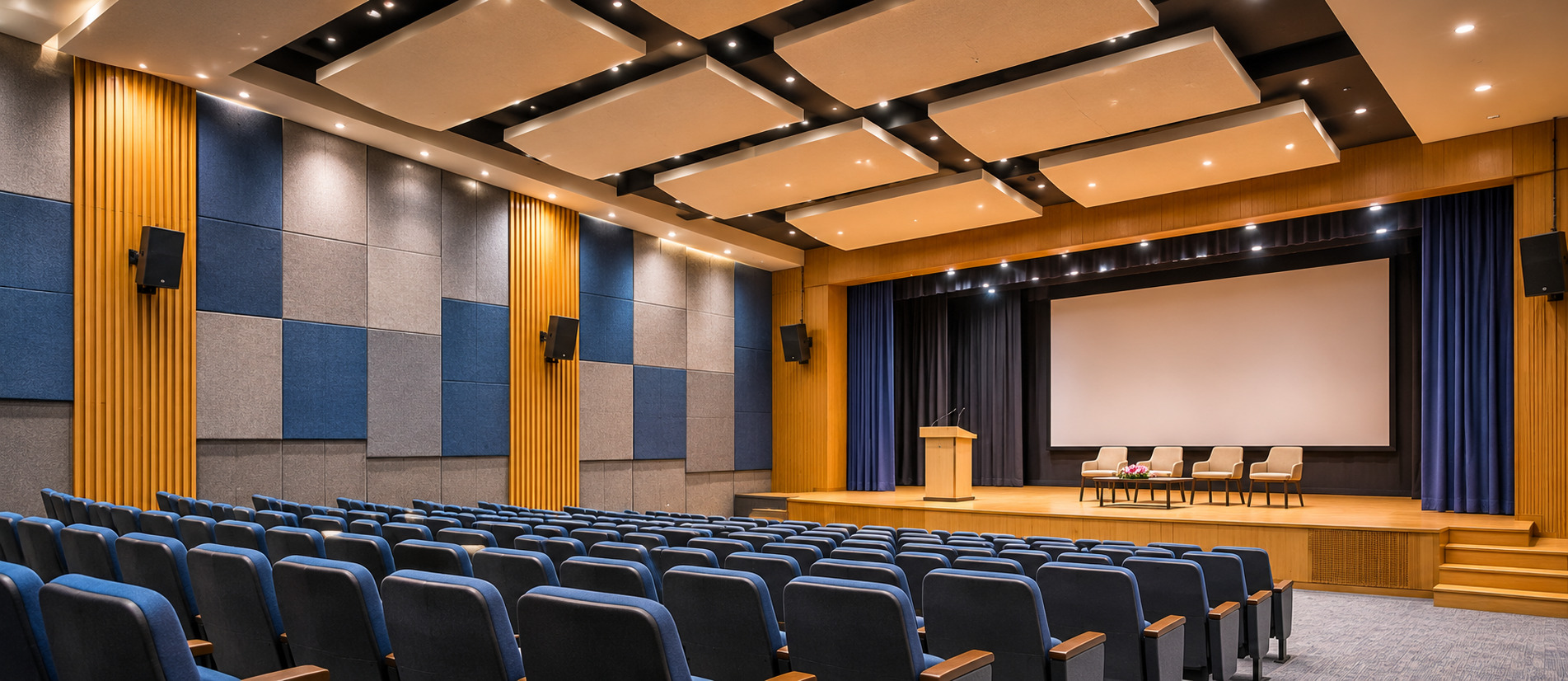
Introduction: Why Auditorium Acoustics Matter
An auditorium must allow every audience member to hear a presentation, performance or announcement clearly. The sound should feel balanced across the seating area, without excessive echo, harsh reflections or distracting background noise. Achieving this requires more than selecting powerful loudspeakers. It calls for coordinated auditorium acoustics design in Adyar, taking the room, audience, stage and sound system into account as one connected environment.
Auditoriums serve many purposes, including school and college functions, lectures, conferences, cultural programmes, community events and musical performances. Each activity places different demands on the room. A space intended mainly for spoken presentations needs strong speech intelligibility, while a performance venue may need a more carefully balanced response for voices and instruments.
Adyar has educational institutions, professional organisations and community venues where halls may be used for varied events. Acoustic planning should therefore begin by understanding the venue's primary and secondary uses, rather than applying a standard treatment without evaluating the space.
Successful auditorium acoustics help the audience hear the intended sound
clearly and consistently, from the front rows to the rear seats.
Common Acoustic Challenges in Auditoriums
Large enclosed halls can produce long reverberation times when sound reflects repeatedly from hard walls, ceilings, floors and balconies. Some reverberation can add a sense of spaciousness to music, but excessive reverberation can blur syllables and make announcements difficult to understand. The appropriate balance depends on the hall's volume, geometry and intended programme.
Other common issues include echoes from distant parallel surfaces, sound focusing caused by curved architectural elements, uneven loudspeaker coverage and noise from air-conditioning or nearby building services. A hall may also sound different when empty compared with a fully occupied event, so the design should account for audience absorption and realistic operating conditions.
Speech Intelligibility for Lectures and Presentations
In lecture halls, conference auditoriums and institutional venues, listeners must distinguish words without strain. Excessive reflected sound can overlap with direct speech, particularly when the speaker is amplified. Background noise from ventilation, projectors, lighting equipment or adjoining areas can further reduce clarity.
Acoustic design can improve the listening environment through suitable reverberation control, careful loudspeaker positioning and attention to background noise. The goal is not simply to make the hall louder; it is to deliver intelligible speech at an appropriate level throughout the audience area.
Room Shape, Volume and Seating Layout
The shape and proportions of an auditorium influence how sound travels. High ceilings, balconies, side walls and rear wall distances can create reflections that affect different seating zones. The stage-to-audience relationship also influences direct sound and the placement of microphones and loudspeakers.
Seating layout should be reviewed alongside the room geometry. The design needs to consider sightlines, audience capacity, accessible seating and the intended location of the sound-control position. Acoustic treatments should support the architecture and circulation rather than obstructing access or essential building services.
Reverberation Control and Acoustic Treatment
Sound-absorbing materials can help manage reflections when selected and positioned according to the room's acoustic requirements. Wall panels, ceiling absorbers, acoustic banners, baffles and upholstered seating may all contribute, depending on their tested performance and installation. The quantity and distribution of absorption matter as much as the product category.
Treatment should be distributed thoughtfully. Absorbing too much sound in the wrong areas can make a hall feel acoustically dull, while leaving key reflective surfaces untreated may preserve distracting echoes. Some venues may benefit from a combination of absorption and controlled reflection to support both speech and music.
Sound-System Planning and Loudspeaker Coverage
A well-designed sound system should provide consistent coverage without creating excessively loud areas near individual speakers. Loudspeaker type, directivity, mounting position, delay settings and system tuning all affect the result. The room's acoustic behaviour must be considered during system planning because electronic amplification cannot fully correct every architectural reflection or reverberation problem.
Microphone selection and placement are also important. Poor microphone positioning can increase feedback risk and reduce clarity. The sound system should be planned around the stage arrangement, presenter movement, performance requirements and the technical team's operating workflow.
Acoustic Requirements for Different Auditorium Uses
- Educational auditoriums: Prioritise clear speech for lectures, assemblies and student presentations.
- Conference halls: Support intelligible discussion, presentations and audio-visual systems.
- Cultural venues: Balance vocal clarity with the requirements of music, dance and stage performances.
- Community halls: Provide flexible acoustic conditions for events with different audience sizes and sound levels.
- Multipurpose spaces: Consider adaptable sound-system settings and acoustic strategies for changing uses.
Controlling HVAC and Background Noise
Mechanical services can introduce continuous noise that becomes especially noticeable during quiet presentations or performances. Air-conditioning equipment, ductwork, fans and vibration from mechanical units should be considered as part of the overall acoustic design. Equipment selection, vibration isolation, duct treatment and airflow planning may help reduce unwanted noise when properly engineered.
External noise and sound transfer from adjoining rooms may also need review. Doors, partitions, glazing and service openings can become weak points in the building envelope. Sound isolation measures should be designed for the actual transmission paths rather than relying on absorptive wall panels alone.
Acoustic Assessment Before Treatment
An effective design starts with a review of the existing hall and its intended performance. Depending on the project, an assessment may consider:
- Auditorium dimensions, volume and architectural geometry
- Stage, balcony, seating and audience capacity
- Reverberation characteristics and audible echo locations
- Background noise from HVAC and other building services
- Existing loudspeaker, microphone and audio-visual arrangements
- Speech, music and multipurpose performance requirements
- Construction details, access and installation constraints
Where appropriate, measurements and listening evaluations can help establish baseline conditions and guide treatment decisions. The recommendations should relate to the hall's use and the acoustic outcomes expected by its owners, operators and audiences.
Coordinating Acoustics with Auditorium Interiors
Acoustic elements should be coordinated with lighting, stage rigging, projection equipment, sprinklers, ventilation and maintenance access. Ceiling absorbers and suspended elements need suitable support and safe clearances. Wall treatments should complement the interior while remaining correctly positioned for their acoustic purpose.
Considering these requirements early in a new build or renovation can reduce later modifications. For an existing auditorium, the design should also account for event schedules, installation access and the need to keep the venue operational where possible.
Auditorium Acoustic Design by Ray Acoustics
Ray Acoustics provides acoustic design solutions for a range of spaces, including auditoriums, educational facilities, conference rooms and other commercial interiors. Each venue requires a considered approach based on its dimensions, construction, occupancy and intended activities.
For an auditorium project in Adyar, identifying the main concern is a useful starting point. The requirement may be clearer speech, more even sound coverage, reduced reverberation, lower background noise or improved sound isolation. These goals can then guide the assessment and selection of suitable acoustic measures.
Conclusion
Auditorium acoustics design in Adyar should bring together room geometry, acoustic treatment, sound-system planning and background-noise control. A hall designed for lectures may need a different acoustic balance from one used for music or multipurpose events, so the intended use must guide every major decision.
By assessing the space before selecting materials or equipment, it becomes easier to address the actual causes of poor speech clarity, uneven coverage and excessive reverberation. Thoughtful coordination with the architecture and technical systems helps create a more reliable listening environment.
If you are planning a new auditorium or improving an existing venue in Adyar, professional acoustic assessment can help identify the requirements and develop a solution suited to the space and its audience.