Introduction: Creating Better Library Acoustics in Mogappair
A library is expected to provide a calm environment where people can read, study, research and work without unnecessary distraction. In Mogappair, libraries and learning spaces may serve school and college students, professionals, children and community readers. Each group uses the space differently, so library acoustics design in Mogappair should begin with the activities the building needs to support.
A room that appears quiet can still have acoustic problems. Footsteps, chair movement, conversations at the reception desk, group study, computer audio and mechanical equipment can combine to create a distracting background. Hard floors, glass, painted masonry and untreated ceilings may reflect sound instead of absorbing it.
Good acoustic planning does not mean making every part of a library completely silent. It means controlling sound so that quiet reading, individual study, collaboration and staff activities can take place without interfering unnecessarily with one another.
A successful library acoustic plan balances quiet zones, collaborative
areas and essential staff functions through suitable room layout,
sound absorption and, where needed, sound isolation.
Common Noise Challenges in Libraries
Library noise is often produced by ordinary activities rather than a single loud source. Small sounds can become noticeable when they repeat throughout the day or travel across an open floor plan. Typical issues include:
- Conversation spill: Discussions near entrances, circulation desks or group tables can reach quiet reading areas.
- Footsteps and furniture movement: Hard flooring, dragging chairs and moving tables can create impact noise.
- Reverberation: Large rooms with reflective walls, floors and ceilings can make even low-level speech sound prominent.
- Mechanical background noise: Air-conditioning, ventilation fans and other building services may affect concentration.
- Equipment and media sound: Printers, computers, headphones that leak audio and audiovisual facilities need considered placement.
Plan the Library Around Different Activity Zones
Zoning is one of the most useful early decisions in library acoustic design. Instead of treating the entire floor as one uniform space, the layout can separate activities according to their expected sound levels. The entrance, reception and circulation counter can be placed away from the quietest reading spaces where the building layout permits.
Quiet Reading and Individual Study Areas
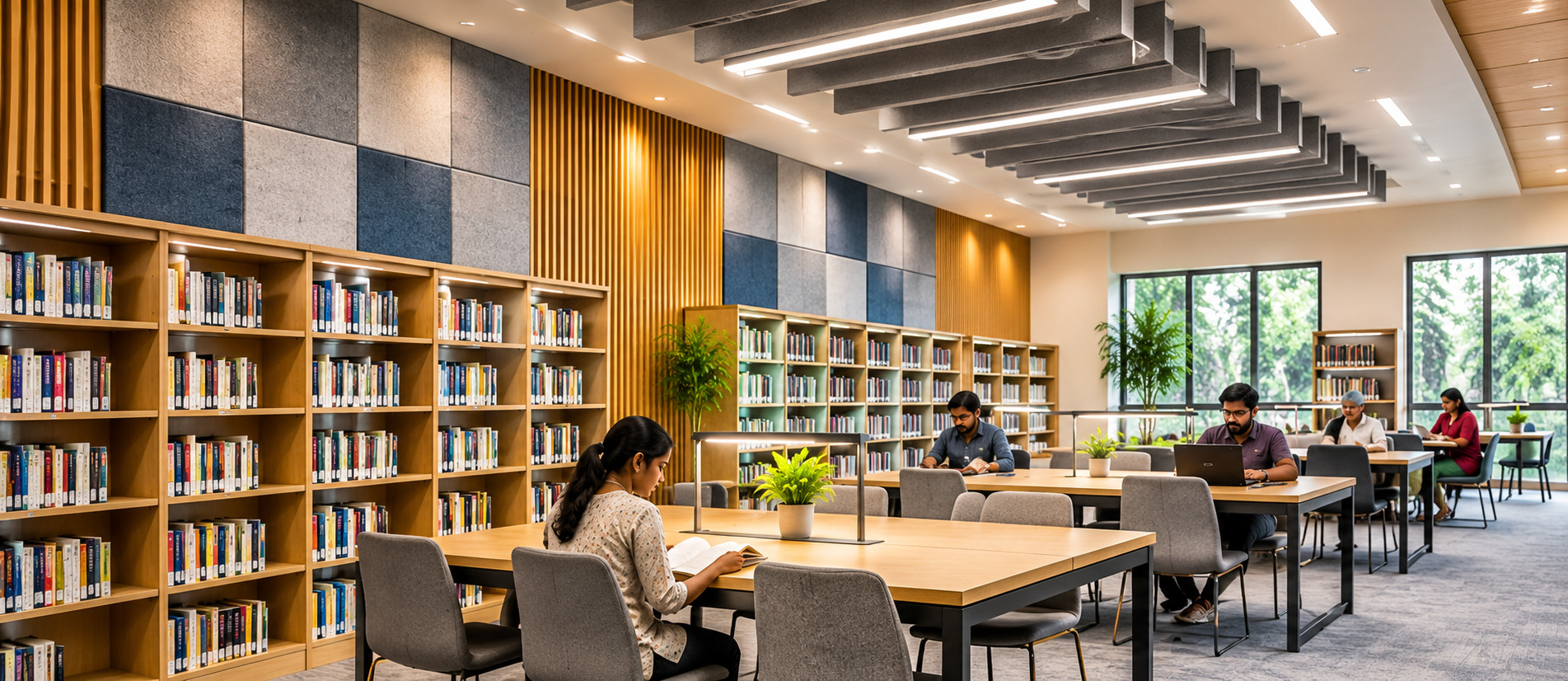
These areas need a low-distraction environment. Locate them away from busy doors, public circulation paths and group discussion tables. Acoustic ceiling absorption and carefully positioned wall treatments can help reduce reflections. Desk arrangements, book shelving and suitable soft finishes can also contribute to a more comfortable space.
Group Study and Discussion Rooms
Group study spaces support conversation and collaboration, so they should not be expected to operate like silent reading rooms. Enclosing these functions in appropriately designed rooms, or placing them in a designated zone, can limit speech spill. Where rooms are enclosed, partitions, doors and junction details should be considered for the required level of sound isolation.
Children's Reading Areas
Children's sections often involve storytelling, reading activities and supervised interaction. A separate location, clear zoning and suitable sound-absorbing finishes can help contain activity while keeping the space welcoming. The objective is to manage sound, not remove the energy that makes the area useful for children.
Staff, Reception and Digital Resource Areas
Staff workstations, issue counters, computer terminals and printing facilities generate a different pattern of sound from quiet study spaces. Their placement should account for visitor movement, equipment operation and the need for staff to communicate clearly.
Control Reverberation with Suitable Acoustic Materials
Reverberation occurs when sound continues to reflect within a room after it is produced. In a library, excessive reverberation can make footsteps, chair movement and conversations seem louder and less distinct. Absorptive materials reduce reflected sound energy and can improve the overall acoustic comfort of the room.
- Acoustic ceiling panels: Useful across larger reading rooms and open study areas where ceiling reflections are significant.
- Suspended acoustic baffles or clouds: Can provide additional absorption while working around lighting and building services.
- Wall-mounted acoustic panels: Can be positioned at suitable reflection points without obstructing shelves or circulation.
- Carpet tiles and resilient floor finishes: May help reduce footfall and furniture noise when selected for the use and maintenance needs of the library.
- Upholstered furniture and soft furnishings: Can contribute to absorption while supporting comfortable seating.
Material selection should consider acoustic performance, fire and safety requirements, cleaning, durability, indoor environment and the library's visual design. Adding panels without identifying the main reflection paths may not deliver the intended improvement.
Improve Speech Privacy Between Library Zones
Some library spaces need more than sound absorption. Meeting rooms, counselling or consultation rooms, staff offices and digital learning rooms may require speech privacy. In these situations, the design should examine how sound travels through partitions, doors, glazing, ceilings and service openings.
A partition that stops below an untreated ceiling, a door with large perimeter gaps or an unsealed cable opening can weaken the overall sound-isolation performance. Acoustic treatment inside a room can reduce reflections, but it does not by itself prevent sound from passing into an adjacent room.
Acoustic absorption controls sound within a room; sound isolation
addresses sound transmission between spaces. Library projects may
need one or both, depending on the activity and adjacency.
Air-Conditioning and Building Services Noise
Comfortable temperature and air quality are essential in a library, but noisy fans, ducts, grilles or equipment can become a constant distraction. Mechanical noise should be considered during design rather than treated as an afterthought. Equipment selection, vibration isolation, duct routing, air velocity and suitable acoustic treatment can all influence the result.
Any proposed noise-control measure should be coordinated with the mechanical and electrical design. Airflow, access for maintenance, fire provisions and the required indoor conditions must remain intact.
Acoustic Design Considerations for Mogappair Libraries
A library in Mogappair may be a compact neighbourhood reading room, an educational institution library or a larger learning facility. The solution should reflect its building type, occupancy and operating pattern rather than rely on a standard material package. During planning, an acoustic designer may review:
- Room dimensions, ceiling height and the relationship between zones
- Existing wall, floor, ceiling and partition construction
- Expected occupancy and peak visitor periods
- Locations of entrances, circulation desks and group activity
- Background noise from roads, neighbouring premises and building services
- Reverberation and speech clarity in reading and study areas
- Privacy needs of enclosed rooms and staff spaces
- Lighting, sprinklers, HVAC, access and maintenance constraints
- Durability, cleanability, fire performance and interior design requirements
Steps in a Professional Library Acoustic Design Process
The process generally begins with a discussion about how the library will be used, the number of users expected and the activities that need to coexist. Available architectural drawings and site conditions can then be reviewed to understand room geometry, construction and potential sound paths.
Where appropriate, site observations or acoustic measurements help establish existing conditions. The design team can then identify whether the main priorities are reverberation control, impact-noise reduction, speech privacy, building-services noise control or a combination of these requirements.
Recommendations should identify suitable treatment types and locations and coordinate them with the architect, interior designer and other project consultants. Installation details and post-installation review can help confirm that the completed space meets its intended use.
Benefits of Well-Planned Library Acoustics
A considered acoustic environment can support the everyday functions of a library in several ways:
- More comfortable conditions for reading and individual study
- Reduced sound reflections in large or highly reflective rooms
- Better separation between quiet and collaborative activities
- Improved speech clarity at service counters and in learning rooms
- Greater privacy in enclosed discussion and staff spaces where designed for it
- Reduced distraction from selected equipment and building-service noise sources
- Better integration of acoustic materials with the library interior
Choosing a Library Acoustic Design Partner in Mogappair
When planning a library in Mogappair, look for an acoustic design approach that begins with the building's actual requirements. Ask how the proposed treatment will address the identified issue, where materials will be installed and how the recommendations coordinate with lighting, ventilation, fire safety and daily maintenance.
A suitable proposal should distinguish between reverberation control and sound isolation, explain the purpose of each recommended product or construction detail, and avoid applying the same treatment to every room. This helps ensure that the investment supports the library's intended activities.
Library Acoustic Solutions by Ray Acoustics
Ray Acoustics provides acoustic design and sound-related solutions for a range of residential, commercial and specialised environments. Library projects can require a combination of acoustic ceilings, wall treatments, noise-control measures and sound-isolation details, selected according to the layout and performance objectives.
For a library or learning space in Mogappair, an assessment of the room layout, sound sources and user activities can help identify practical ways to create a more comfortable environment for reading, research and group learning.
Conclusion
Effective library acoustics design in Mogappair involves more than installing sound-absorbing panels. It requires thoughtful zoning, control of reverberation, attention to mechanical and impact noise, and suitable sound isolation wherever privacy is important.
By considering the needs of readers, students, staff and visitors from the beginning, a library can become a calmer and more functional place for focused study and shared learning. Ray Acoustics can help evaluate the acoustic requirements and plan solutions suited to the purpose of the space.