Introduction: Managing Noise in Koyambedu’s Busy Commercial Environment
Koyambedu is widely associated with major transport and wholesale activity, alongside shops, offices, food businesses and residential buildings. For interiors located in active surroundings, acoustic planning can help address both noise entering a building and sound building up inside a room. The needs of a wholesale office, a customer waiting area and a nearby apartment are not the same, so the solution should be based on the actual use of each space.
An acoustics designer in Koyambedu, Chennai can examine the sound environment, identify likely noise paths and recommend appropriate measures. These may include room treatment, building-envelope improvements, equipment noise control or a combination of approaches.
A quieter room is not achieved by using one product everywhere.
The design must distinguish between sound reflecting inside
a room and sound entering or escaping through the building.
Understanding Traffic and Activity-Related Noise
Transport movement, loading and unloading, vehicle horns, people and nearby commercial operations can contribute to a changing outdoor sound environment. How much of that sound is heard indoors depends on distance, building orientation, façade construction, windows, doors and ventilation openings.
If external noise is the main concern, the assessment should focus on the paths through which it enters. Window and door seals, gaps around frames, lightweight partitions and other weak points may limit the performance of an otherwise substantial wall. The suitable improvement depends on the building and the frequency characteristics of the noise.
It is also important to consider ventilation. Closing openings may reduce some noise but can conflict with fresh-air requirements or comfort. Any acoustic upgrade should be coordinated with the building’s ventilation strategy rather than treated as an isolated change.
Acoustic Requirements for Warehouses and Business Offices
Offices associated with trading, logistics and distribution need practical conditions for phone calls, coordination and meetings. Hard floors, exposed ceilings and large open areas can create long reverberation times. This may make speech less distinct and increase the effort needed to communicate.
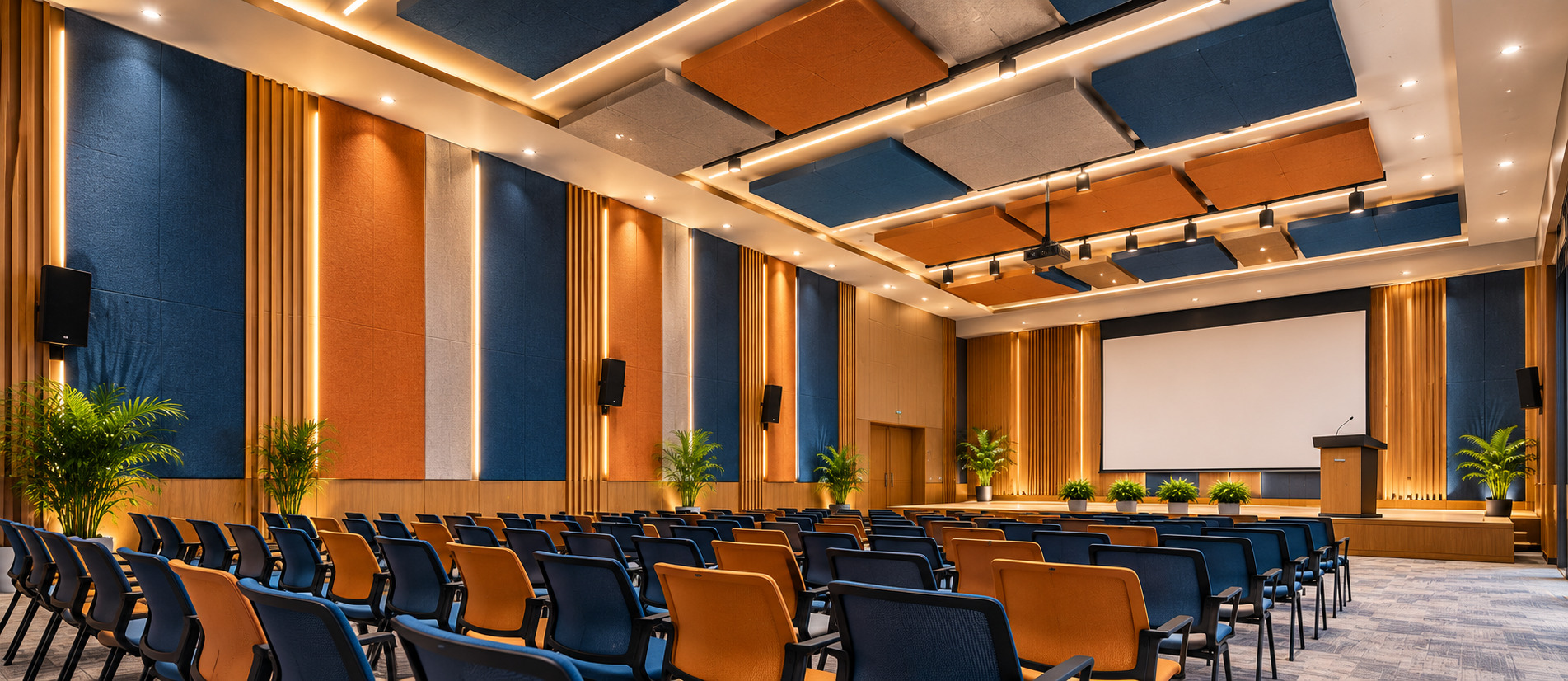
Absorptive ceiling systems, wall panels and selected furnishings can help control reflections in occupied rooms. In larger work areas, treatment locations should be planned around desks, meeting points and the main speech paths. Equipment such as printers, compressors or other machinery may need separate source control or enclosure measures.
In warehouse or service areas, acoustic objectives should account for operational safety and workflow. Any enclosure, barrier or absorptive treatment must remain compatible with access, visibility, fire provisions and equipment maintenance.
Improving Comfort in Shops, Waiting Areas and Restaurants
Customer-facing spaces often combine conversations, announcements, background music and equipment sounds. Reflective tile, glass and hard ceiling surfaces can make these sounds overlap. This can be particularly noticeable in waiting areas, dining spaces and compact shops during busy periods.
A balanced acoustic plan can use ceiling absorbers, wall treatments and soft finishes to reduce excessive reflections. The aim is not necessarily to eliminate all ambient sound, but to make conversations clearer and the overall sound environment more comfortable. Material selection should also consider cleaning, durability and the visual character of the business.
Soundproofing and Room Acoustic Treatment Are Different
Soundproofing or sound isolation aims to reduce sound transmission between spaces or from outdoors. It may involve mass, airtightness, suitable construction details and control of flanking paths. Acoustic treatment, by contrast, manages reflections within a room using absorptive or other purpose-designed elements.
A meeting room with echo may benefit from absorptive treatment, while a room disturbed by nearby machinery may need source control or isolation work. Applying panels to the interior surfaces will not, by itself, stop substantial outside noise from passing through a weak window or opening.
How an Acoustic Assessment Guides the Design
- Discuss when and where the noise is most disruptive, including the activities taking place at that time.
- Inspect the room layout, surface finishes, doors, windows and adjoining spaces.
- Identify whether the concern is external noise, sound transmission, reverberation or equipment noise.
- Use suitable observations or measurements to establish a baseline where needed.
- Set practical performance goals and coordinate the proposed work with interiors, ventilation and building services.
This process helps avoid unnecessary material use and makes it easier to explain what a proposed treatment is intended to achieve. Existing buildings may have constraints that influence the scope of work, while new projects can incorporate acoustic requirements into the design from an earlier stage.
Acoustic Solutions from Ray Acoustics
Ray Acoustics works on acoustic design and noise-control requirements for residential, commercial and specialised spaces in Chennai. Depending on the project, solutions may include sound isolation planning, acoustic ceilings, wall treatments, conference room acoustics, studio treatment and mechanical noise control.
For projects in Koyambedu, the design approach should reflect the local site conditions as well as the building’s purpose. A project-specific assessment can help determine whether the priority is reducing incoming noise, improving speech conditions or controlling sound from equipment and operations.
Conclusion
Koyambedu’s mix of transport-related activity, commercial operations and occupied buildings creates a range of acoustic considerations. Offices may need clearer communication, customer areas may need better control of reverberation, and noise-exposed rooms may require attention to sound transmission paths.
Consulting an acoustics designer in Koyambedu, Chennai can help connect the observed noise problem with a suitable design response. Understanding the source, the building and the room’s intended use is the foundation of an effective acoustic plan.